
Gender Mainstreaming in Justice & Accountability Processes Works. Period.
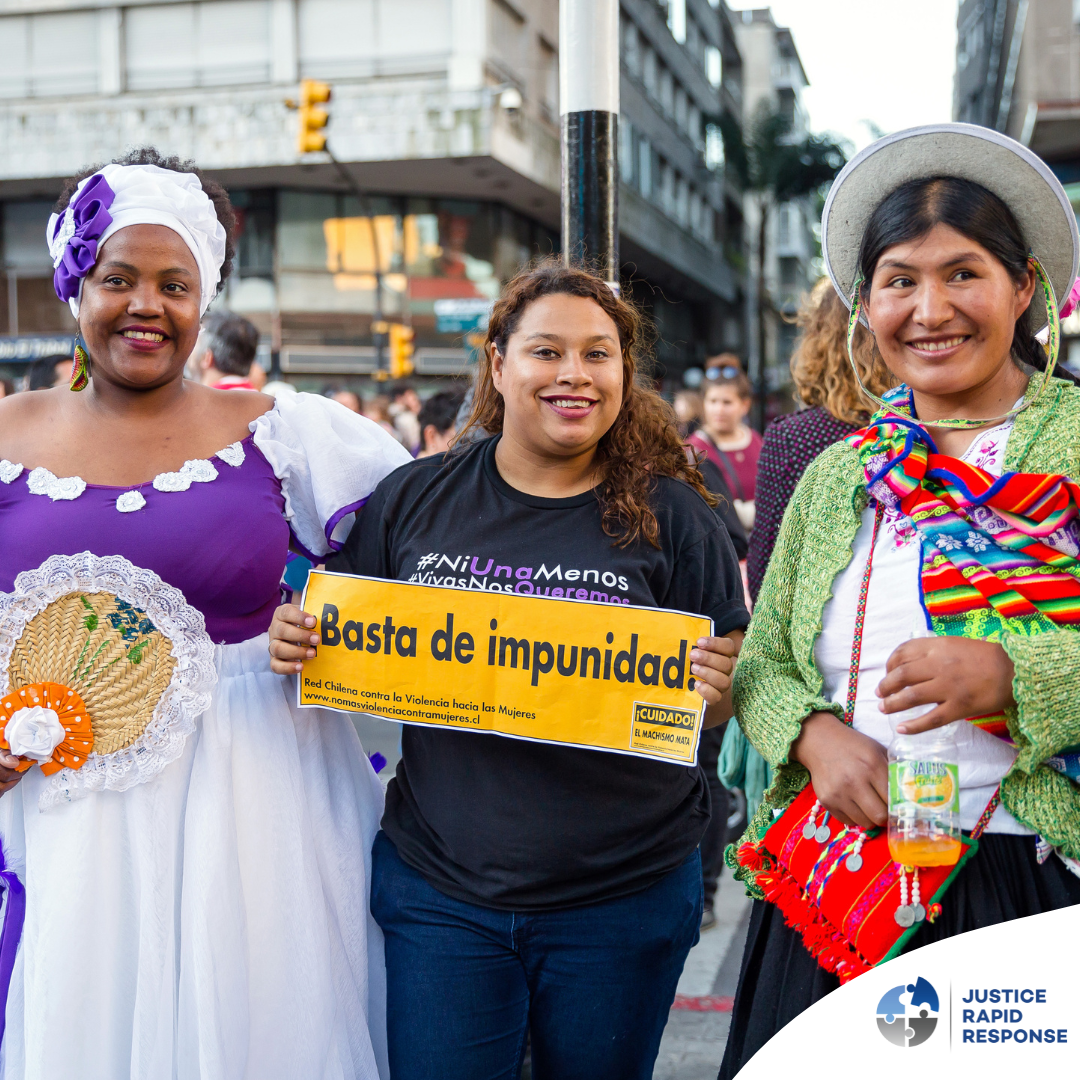
In Uruguay, UN Women representatives, along with Luiza Carvallo, UN Women Regional Director for Latin America and the Caribbean, joined a march in Montevideo to end violence against women. Credits: UN Women & Sahand Minae, 2017.
Authors: Mary Díaz Márquez, Senior Programme Officer, and Olivier Clavet, Senior Communications and Public Partnerships Officer at Justice Rapid Response.
Gender mainstreaming in justice and accountability processes is a proven strategy that delivers tangible results. Yet, diversity and inclusion policies are being rolled-back – both in the public and private sectors; and entire programmes are dismantled as they are now considered as “wasteful.” This is the new reality, and it’s victims and survivors of international crimes and serious human rights violations that will suffer in the long run.
Promoting a “gender-based approach” is far more than just a fancy term — it’s a crucial foundation for ensuring that justice is truly inclusive and effective for all victims. It recognises that women, men, girls, boys and gender-diverse and LGBTQI+ individuals experience the world in distinct ways, shaped by their unique needs, roles, and opportunities. These differences influence how people experience victimisation, and this is where intersectionality becomes essential. Factors like disability, race, age, sexual orientation or socio-economic situation often create additional barriers for marginalised groups in accessing justice and obtaining reparations. It’s no surprise, then, that these intersecting factors also make people, especially those in the midst of armed conflicts or under authoritarian regimes, more vulnerable to sexual and gender-based violence.
All forms of gender-based violence need to be effectively accounted for. And to ensure greater impact, all forms of human rights violations should also be investigated through gender-sensitive lens. Otherwise, countless violations remain undocumented, and many victims thus remain invisible, jeopardizing their chances of obtaining redress.
Why? Because it works – it is as simple as that.
Gender mainstreaming is not only vital for addressing past injustices — it’s equally crucial for shaping a more just and sustainable peace. In peace processes, for example, women and gender non-conforming are often excluded from negotiations, despite being among the most affected by conflicts.
Yet, research consistently shows that their inclusion makes a measurable difference: it increases the likelihood of a peace agreement lasting at least two years by 20%, and by 35% for agreements that endure 15 years.[1] A good example is the case of Colombia, where women have helped shape the current transitional justice process.[2]
With this in mind, gender mainstreaming ensures that all the voices, experiences, and needs are not only heard, but that they actively shape peacebuilding efforts.
In other words, it is a proven and effective tool that leads to build safer, inclusive and more pacific societies.
The Case of Latin America
Let’s take the case of Latin America. The Ibero-American Association of Prosecutors[3] (AIAMP) recently published a regional protocol for the investigation of sexual violence cases in Latin America with the support of Justice Rapid Response’s gender expertise and partners. The Protocol provides guidelines for investigating sexual violence cases, tailored to some specific realities faced in the Latin American context.
Drawing from global norms and international human rights instruments, the protocol provides detailed instructions on how to safely interact with and interview survivors of sexual violence, and includes a broad definition of sexual violence focused on lack of consent. This is important given that, traditionally, criminal justice systems have required sexual conduct to be carried out through the use of physical force in order to characterise certain types of sexual abuse, particularly rape. However, reality showed us that perpetrators do not necessarily resort to physical force to commit sexual violence. In practice, it is common to encounter cases in which victims are subjected to threats, emotional abuse, or other forms of coercion that result in sexual violence. Unfortunately, such circumstances are too often disregarded or, worse, misinterpreted as indications of consent, rather than being properly recognized as constitutive elements of the crime.
In the Latin American context, a clearer understanding of consent (or the lack of it), as well as the implications of a cohesive context, is crucial. Many Latin American countries deal with complex and deteriorating security conditions, such as armed conflicts like the one in Colombia and certain areas of Central America that are hugely affected by gang violence or organised crime targeting women and LGBTQ+ individuals. Being aware of these circumstances, for example when victims do not “resist” or fight back (which is a common “requirement” that people misguidedly consider mandatory to prove lack of consent), can lead to more cases being investigated. Such initiatives are all the more urgent in a region that faces some of the world’s highest rates of gender-based . In fact, 14 of the 25 countries in Latin America rank among those with the highest femicide rates globally.[4]
Understanding the broader context becomes crucial when investigating sexual violence. As the Protocol explains, “contexts are spaces or environments that foster situations of sexual violence, facilitate them, or in which, due to various factors, they occur regularly.[5]” Contextual investigation is particularly valuable when a complaint is filed long after the incident or when biological evidence is unavailable. For example, it is well known that sexual violence is often systemic in armed conflicts. Armed groups use it as a weapon of war and as a tool to intimidate populations. Recognizing this pattern helps national authorities understand individual allegations within a broader phenomenon, supporting victims’ claims even when some evidence is lacking, rather than treating them as isolated events. It is also a way to link sexual violence cases to the investigation of other crimes.
Within the Protocol, emphasis was also placed on translating a “survivor-centered approach” into actual actionable guidelines. For instance, the Protocol indicates that the sexual violence victim’s well-being and autonomy should take precedence when handling their information, and prohibits reliance on myths and stereotypes about victims’ behavior, appearance, prior sexual history, or relationship with the accused when assessing consent or credibility. It underscores the critical need to prevent revictimization and details how to put into practice a trauma-informed approach when evaluating a victim’s testimony.
This approach not only facilitates a more empathetic understanding of the survivor’s experiences, but also provides a framework for using their testimony to substantiate the presence of trauma. The Protocol finally provides for the possibility to influence positively the manner in which victims and survivors from all members States of the AIAMP are treated, contributing to securing a trauma-informed approach in investigative efforts addressing sexual violence in Latin America, but also Spain and .
Key Results at the National Level: The Case of Colombia
Beyond the progress at the and regional levels, there are compelling examples at the national level demonstrating the positive impact of a gender-centered approach.
One of them comes from the work of Colombia’s Special Jurisdiction for Peace (JEP). In its first indictment in Macro-Case 07 (case focusing on the recruitment and use of children in armed conflict) against former commanders of the FARC-EP guerrilla, the JEP revealed how the “rules” imposed on combatants had clear gender implications that placed women at heightened risk of sexual and gender-based violence (SGBV). For example, women were subject to “dating rules” — restrictions that did not apply to men — which forbade relationships outside the armed group. Also, female combatants, unlike their male counterparts, were also compelled to take contraceptive pills, often by force, and in multiple cases were victims of forced abortions and sterilizations. This so-called “contraception policy,” designed to facilitate military life, placed disproportionate and gender-specific burdens on women and girls. By approaching the investigation of serious human rights violations through a gender-sensitive lens, the JEP was able to broaden the scope of charges for gender-based crimes committed within the armed group and expose these long-hidden practices that had remained invisible for decades.
Conclusion
The case of Colombia at the national level, alongside the development by the AIAMP of a new Protocol on sexual violence at the regional level, demonstrates the success of prioritizing gender mainstreaming in justice and accountability processes. These case studies clearly show that by adopting this approach, national institutions can uncover patterns of violence that would otherwise remain invisible, while simultaneously amplifying the voices of survivors.
Gender mainstreaming works – why would we let go of this critical tool ? This is not the time to back down: on the contrary, replicating similar initiatives is crucial, as it guarantees victims’ rights while bringing back hope in a world that direly needs it.
[1] Women’s Participation and a Better Understanding of the Political | Global study on the implementation of UN Security Council resolution 1325
[2] UN Women, 20205. “The Peace Deal That Put Women First: What Colombia Taught The World”. Online. URL : https://www.unwomen.org/en/news-stories/feature-story/2025/07/the-peace-deal-that-put-women-first-what-colombia-taught-the-world. Consulted on Sept. 9, 2025.
[3] The Asociación Ibero Americana de Ministerios Públicos (AIAMP) is an organization that brings together the Public Prosecutor’s Offices of Latin American countries, Spain and Portugal. It is composed of Prosecutor General’s Offices of 22 countries. The Red Especializada en Género (REG) is an official AIAMP working group, composed of General Prosecutor Offices representatives specialized in gender issues
[4] For more information: https://gbv.wilsoncenter.org/explore-gbv-data
[5] Red Especializada en Género, Asociación Iberoamericana de Ministerios Públicos, Modelo de Protocolo Iberoamericano para la Investigación de Casos de Violencia Sexual, 2024, p. 58.