
JRR and UN Women Launch Their New Guidance & Practical Tool on Intersectionality
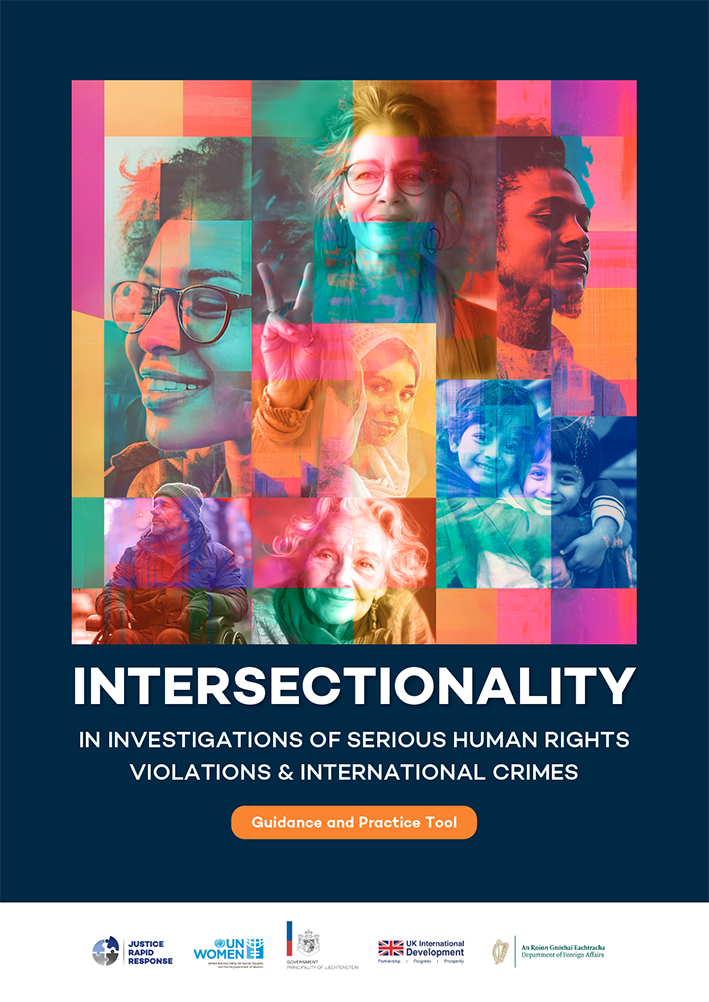
Justice Rapid Response (JRR) and UN Women are launching their new Guidance and Practice Tool on Intersectionality in investigations of serious human rights violations & international crimes. The Guidance on Intersectionality will help justice actors apply an intersectional approach in investigations of international crimes and human rights violations.
Applying such an approach helps identify injustices rooted in the compounded and interconnected nature of discrimination. As Professor Patricia V. Sellers outlines in the forward:
“The concept highlights how the intersecting aspects of a person’s identity can make them more vulnerable to human rights violations and/or international crimes. These interlocking identities do not automatically correlate with vulnerability, but in specific contexts, they can be the driving factors behind targeted harm.”
An intersectional lens provides crucial information on how identities, social narratives, discrimination and privilege have shaped the intent of the perpetrators. It is also an instrument of self-reflection on the investigator’s own privilege and methodology in their justice practice. Relying on such approach in justice and accountability work is thus critical in understanding the full scope of the harm endured by victims and survivors, contributing to shedding light on overlooked crimes and violations.
This initiative stems from the fact that there is still little guidance that fully focuses on the use of an intersectional lens in our sector and while practitioners embrace the value of this lens, they also seek concrete guidance on how to operationalize it. The Guidance on Intersectionality provides a definition of intersectionality relevant for justice and investigation processes, and gives concrete recommendations and checklists on how this analytical framework can be applied in the preparation, planning, collection of information, analysis and reporting phases of an investigation.
Concrete examples of best practices are also highlighted in the Tool and form the basis of its recommendations. For instance, practitioners will find how the UN International Commission of Human Rights Experts on Ethiopia – supported by JRR with technical expertise – applied an intersectional approach to source identification. The Commission deliberately diversified its sources to reflect the voices and experiences of people from different backgrounds and communities, including individuals identifying with different (and mixed) ethnicities, older persons, persons with disabilities, minorities, refugees, and internally displaced persons. Gathering information from the widest possible range of sources enabled the Commission to identify a common thread in violations and abuses against the Tigrayan community: an intersectional discriminatory intent based on ethnicity and gender, in violation of international and regional human rights treaties.
The Guidance on Intersectionality ultimately seeks to offer a concrete framework for investigators. By facilitating the application of an intersectional approach in justice work, this tool aims to broaden access to justice and redress for victims and survivors, recognizing victims not just for one harm but the combined harm they may have suffered, allowing to establish effective remedies, and ensuring a more inclusive and comprehensive approach to justice processes.
Some of the legal minds who have been spearheading intersectional work in international justice, including Priya Gopalan, Alexandra Lily Kather and Patricia V. Sellers, contributed to this document, together with experts from the community of gender advisors and sexual and gender-based violence investigators deployed to international investigations by JRR, UN Women and OHCHR. JRR is very grateful for the contribution of its partners in developing this document.
This project was made possible by the support of UN Women and was primarily funded by UK International Development. JRR thanks UN Women, Ireland, the Principality of Liechtenstein, and the United Kingdom of Great Britain and Northern Ireland for their contributions to this project.