
Justice Process in Ukraine: Key Takeaways from High-level Event on Accountability
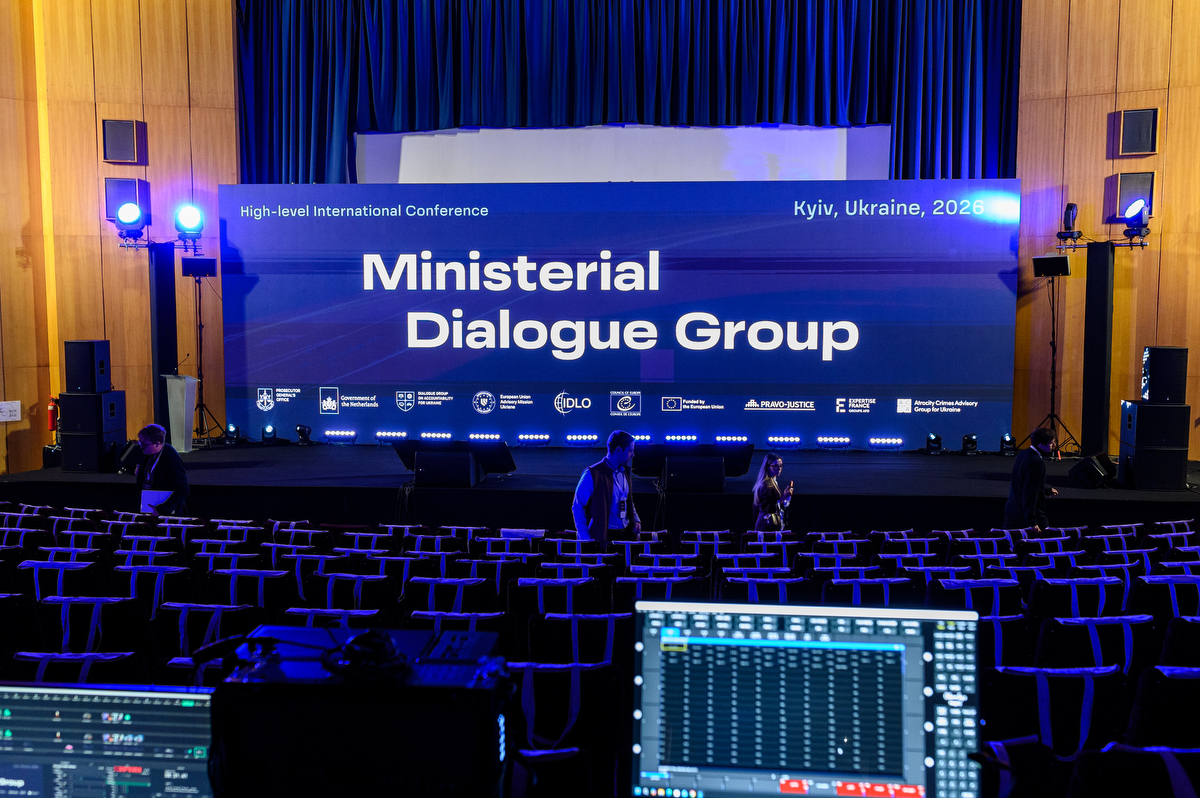
Photo: United for Justice/ Ukraine OPG.
Last month, on 7 May 2026, Kyiv hosted a major high-level accountability event combining the third Ministerial Meeting of the Dialogue Group on Accountability for Ukraine and the 9th conference of the United for Justice initiative, dedicated to accountability for crimes committed against civilians in the context of Ukrainian armed conflict. Justice Rapid Response (JRR) had the chance to attend these two gatherings and to meet with key stakeholders involved in justice and accountability efforts in Ukraine. Here are the main takeaways from these two important events to advance justice processes in Ukraine.
Co-organised by the Ukrainian Office of the Prosecutor General (OPG) and the Government of the Netherlands, the JRR team could meet with a wide range of justice actors, including international justice mechanisms, Ukrainian state institutions and local civil society organizations involved in accountability efforts. This was an occasion for JRR to identify new partners and new areas of work to focus on, and to strengthen our collaboration with the many organizations we already support on the ground with the deployment of justice and human rights experts from the JRR Roster.
Overall, the discussions focused on legislative harmonisation following Ukraine’s ratification of the Rome Statute, strategic approaches to investigations and prosecutions of international crimes, crimes committed in temporarily occupied territories, attacks on critical infrastructure, unlawful detention, crimes against children, and the increasing use of drones against civilians.
Open-source investigation techniques was also among the key issues addressed, as participants recognized how essential the latter have become for modern war crimes investigations. Specifically, speakers and participants stressed the importance of integrating such techniques into prosecutorial work to strengthen analytical capacities; increasing reliance on digital evidence collection; strengthening cooperation between different fields of expertise, such as prosecutors, analysts, military experts, and intelligence actors; and buttressing the adoption of specialized expertise in handling large-scale datasets in complex investigations.
On victim-centered approach, many actors stressed that effective victim protection requires all institutions to work together through a coordinated approach rather than fragmented institutional responses. Further, participants also insisted on the fact that that victim-centred justice must become a practical institutional culture rather than a formal policy declaration
One element that speakers and participants repeatedly stressed during these two events is the key role of international cooperation and the importance of relying on a broad range of expertise in accountability work. More than ever, international crimes investigations increasingly require multidisciplinary approaches involving not only prosecutors and investigators but also military experts, analysts, OSINT specialists, psychologists and victim-support professionals.
The OPG also took the opportunity to present its new 2026–2028 Strategy for the prosecution of international crimes, the implementation of which JRR will be supporting with expertise on its Roster.
In this context, JRR remains a key player in advancing justice processes in Ukraine by ensuring that its partners – at the international, national and local levels – are able to benefit from the expertise they need at the right time, thus contributing to promoting an inclusive, gender and child sensitive, and holistic approach to justice in Ukraine. JRR will continue working hand-in-hand with its partners to promote the rights of Ukrainian victims and survivors and their access to justice.
JRR is grateful to its donors, including the Ministry of Foreign Affairs of the Netherlands, for their support to its activities in Ukraine.