
Screening Event Highlights of JRR’s New Short-Documentary Film on Ukraine’s Justice Processes
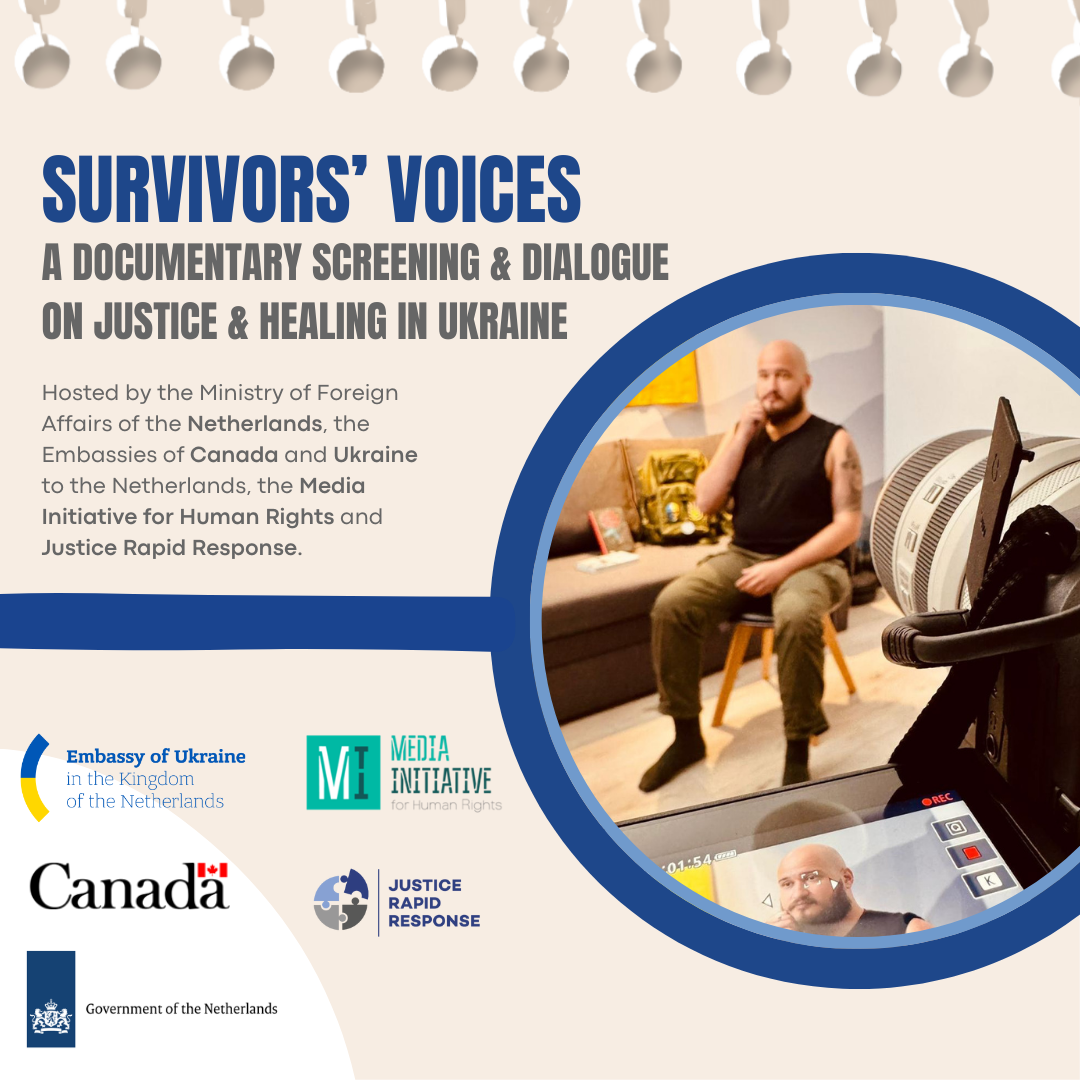
This month, we had the chance to host, in partnership with the Embassies of Canada and Ukraine to the Netherlands, the Ministry of Foreign Affairs of the Netherlands and the Media Initiative for Human Rights (MIHR) a screening event of our new short-documentary film on Ukraine justice process, Surviving Izolyatsia.
The panel discussions that followed was an occasion to learn more about the challenges faced in the context of the country’s justice process, but also the innovative solutions being implemented to keep advancing towards a true victim-centered justice.
Here are some highlights of this screening event:
- The Ukrainian authorities seek to ensure that the rights of victims and witnesses of the Russia–Ukraine war are fully protected and respected. With the establishment of the Coordination Center for the Support of Victims and Witnesses within the Office of the Prosecutor General (OPG), they seek to achieve this goal.
- The Center is mandated to provide effective support — such as legal, psychological, and practical assistance — to war-affected victims and witnesses registered in ongoing criminal proceedings. It fulfils this mandate by advocating for their rights and coordinating with relevant authorities and service providers on their behalf.
- In addition, the Center is developing an online referral platform (to be launched shortly) to further strengthen its support and outreach. The platform will streamline referrals to relevant service providers, including civil society organizations (CSOs), capable of delivering multisectoral and tailored assistance.
- Justice Rapid Response (JRR) has deployed a Victim and Witness Support Expert to assist the Center in conceptualizing the platform and ensuring that it is needs-responsive, victim-centered, and sustainable. This includes guaranteeing accessibility for persons living with disabilities and ensuring that the safety and security of victims living in the Temporarily Occupied Territories of Ukraine are not compromised when using the platform.
- Support from the international community is essential to ensure these initiatives materialise and contribute to promoting the rights and access to justice of victims and survivors in Ukraine. A clear and concrete example of this international support is the establishment of the Register of Damage for Ukraine, hosted by the Council of Europe, and the emerging International Claims Commission for Ukraine, thanks to the leadership of the Netherlands, among others.
- Ukrainian civil society plays a central role in documenting and addressing atrocities committed in the context of Ukraine – this includes the Media Initiative for Human Rights, a Kyiv-based CSO documenting and investigating enforced disappearances and other grave violations since 2016, which JRR supported with technical support. For instance, they recently curated a virtual reality exhibition detailing the detention conditions of civilian populations in Russian and Pro-Russian forces-controlled detention sites. Justice actors from the civil society are critical in supporting nationally and internationally led accountability efforts.
- To date, MIHR has recorded 3,756 cases of enforced disappearances of civilians from temporarily occupied territories, with more than 2,300 individuals still in captivity. The organization has identified over 160 detention sites across Russia and occupied regions, and recent interviews with released civilians show that 91% reported torture — indicating a systematic policy rather than isolated abuses.
- Beyond documentation, MIHR develops innovative memorialization and advocacy tools to make these crimes visible — including a portrait-based campaign, an international exhibition, and a VR experience based on sketches created by a detainee held for more than three years. These initiatives support global awareness, diplomatic engagement, and efforts for the release of civilian detainees, contributing to both accountability and victim-centred justice.
JRR wishes to thank Lyudmila Heysenova and Daniil Bulgakov for sharing their story with us, and for contributing to making Ukraine’s justice processes effectively victim-centred. The film was directed by Nicolas Braguinsky Cascini and Juan Pablo Aris Escarcena from Mandorla Films and produced by JRR.
This project was made possible thanks to the contribution of the Ministry of Foreign Affairs of the Netherlands and the Government of Canada through Global Affairs Canada.